
Mob Era: Age Evolution
Horusent SingAction
4.5302.00 Reviews
- Version
- 0.0.3.4
- Installs
- 1.00M
- Age Rating
- Everyone
Screenshots
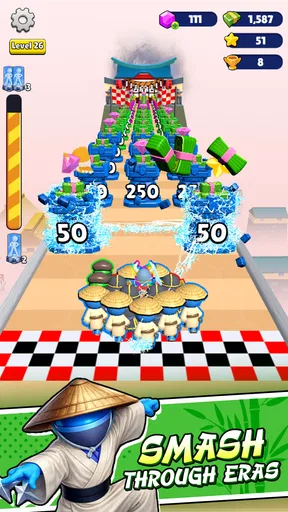
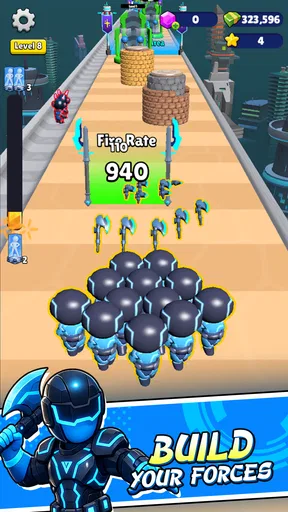
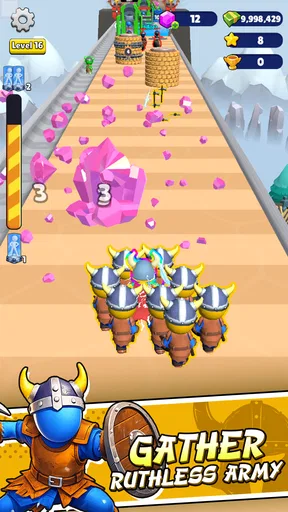
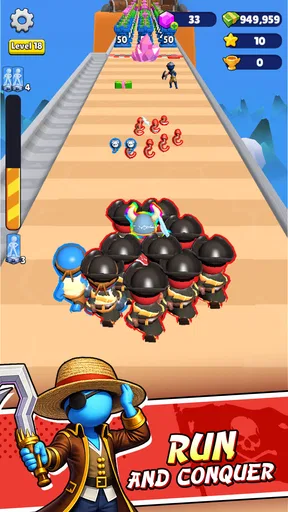
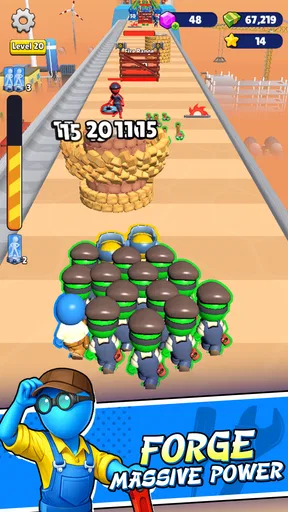

Our Review of Mob Era: Age Evolution
 Analysis by Appyee
I approached Mob Era: Age Evolution as the kind of action game I could pick up for a few minutes, make a handful of decisions, and put down without needing a long explanation. That first impression is important because its central idea is immediately readable: move through changing eras, build up a crowd, and keep growing until your force can overwhelm what stands in the way. It is a free game from Horusent Sing, aimed at Everyone, and it has the quick visual premise that often makes mobile action games easy to understand at a glance.
What makes it worth a closer look is not simply the promise of getting bigger. The interesting question is whether the era progression and crowd-building loop give you enough meaningful choices to stay engaged, or whether the experience becomes a repetitive chase for a larger number on screen. After spending time with it, I see it as a lightweight action choice for players who enjoy visible momentum and short sessions, rather than as a deep strategy game or a long-form adventure.
How to decide whether Mob Era: Age Evolution fits you
I would judge this game by four practical criteria. First, do you enjoy immediate action more than detailed planning? Second, do you like progression that is shown visually through a growing force and changing surroundings? Third, are you comfortable with a free-to-play structure that includes optional purchases? Finally, do you want a game that is simple to understand quickly, or are you looking for a system with extensive customization and long-term complexity?
Those questions matter because the appeal here is concentrated. The game’s store short description is “Mob Era,” and that tells you more about its identity than a long list of features would. The focus is the mob itself: gathering strength, moving forward, and turning that strength into control. I found that the most satisfying moments came from making the crowd feel increasingly capable, not from studying a large collection of menus or mastering a complicated ruleset.
For a player who wants a calm puzzle, a traditional role-playing game, or a competitive action title that depends on precise timing, this may not be the best first choice. The game is better suited to someone who wants a direct loop with a clear visual payoff. I would especially recommend trying it when you want something less demanding than a full campaign but more interactive than simply watching progress bars fill.
The age rating of Everyone also makes the game easier to consider for a broad household audience. That does not mean every player will enjoy it equally. Younger or casual players may appreciate the straightforward concept, while experienced action fans may quickly ask for more depth. The right fit depends less on age than on how much complexity you expect from a mobile game.
The basic loop rewards visible momentum
The core rhythm is easy to explain without reducing it to a slogan. You move through an era, gather forces, improve your position, and try to finish with enough strength to conquer the obstacles in front of you. I liked that the game communicates progress through what happens on the playfield. Instead of relying only on abstract menus, it makes growth feel like something I can see developing during a run.
That visual feedback creates a useful decision habit: I learned to think about each movement as a choice between immediate gain and safer continuation. When the crowd is small, careless movement can make a run feel fragile. Once the group has grown, the same route can feel much more forgiving. This changing sense of risk is one of the better reasons to pay attention rather than simply holding a direction and waiting for the level to end.
A practical tip is to avoid treating every available gain as automatically valuable. In a crowd-building game, a larger group is tempting, but the route toward it can matter just as much as the reward. I found it more useful to preserve a stable force first, then take opportunities that improved the run without putting the entire advance in a bad position. That approach is especially helpful during short sessions, when restarting repeatedly can make a simple game feel unnecessarily tiring.
The era theme also gives the progression a sense of movement. Even when the underlying action remains familiar, passing from one period to another helps the experience feel like a journey rather than a single repeated arena. I would not approach it expecting a history lesson or a detailed simulation. The eras work primarily as a presentation and progression framework, giving the forward motion a recognizable shape.
Where the game wins over heavier action alternatives
Its strongest advantage is accessibility. I did not need a long preparation period before understanding what I was trying to do. That makes it a good companion for a commute, a short break, or the few minutes before an appointment. A heavier action game may offer more abilities, equipment, maps, or narrative, but it can also demand more attention than I have available in those moments. This game’s direct structure is useful precisely because it does not ask me to remember a large amount of information.
It also wins when the player wants progress that is easy to read at a glance. The growing force provides a simple visual measure of how well a run is going. That clarity is more satisfying than a purely numerical upgrade system for players who like seeing the result of their choices immediately. I could tell when a run had changed character: a small group felt vulnerable, while a larger one made the path ahead feel more manageable.
Another strength is the relationship between movement and decision-making. This is not deep strategy in the board-game sense, but it is more active than an idle game. I still need to pay attention to positioning, route selection, and the timing of risk. That middle ground may appeal to people who find idle progression too passive but consider traditional action games too demanding.
For an everyday example, I would use it during a ten-minute wait at a café. I could start a run without first checking a character build, reviewing a quest log, or remembering a complicated control scheme. If I had to stop, the game’s basic objective was simple enough that returning did not feel like re-entering a large unfinished task. That makes it more convenient than many campaign-based alternatives for fragmented free time.
Small habits that make each run feel less wasteful
The first habit I recommend is watching the shape of the route rather than focusing only on the nearest reward. A nearby gain may look attractive, but a route that keeps the group together can be more valuable than a risky detour. This is a modest distinction, yet it changes the way the game feels: I stopped reacting to every visible opportunity and started planning one movement ahead.
The second is to use the early part of a run as a setup phase. When the force is still limited, I treated that time as an opportunity to establish a safe rhythm instead of chasing every possible advantage. Once the crowd was stronger, I became more willing to take aggressive paths. This creates a natural two-stage approach—stabilize first, then push—which is more reliable than playing every moment at maximum speed.
The third is to separate progress from impatience. A failed run can make it tempting to spend immediately in order to recover momentum, but I would first ask whether the problem was route selection or timing. If the same mistake keeps happening, a purchase may only hide the issue temporarily. The better value comes from learning which choices make the force vulnerable and which ones preserve it.
These are not secret controls or complicated exploits. They are small ways of reading the game’s feedback more carefully. They matter because a straightforward action loop can become repetitive if every run is played automatically. Paying attention to route quality and crowd stability gives the basic premise more texture.
Where another category may fit better
I would choose a conventional strategy game instead if my main goal were detailed planning, resource management, or long-term construction. Mob Era: Age Evolution gives me the feeling of expansion through movement and crowd growth, but that is different from managing a settlement, balancing several resources, or directing a large campaign. Players who want those systems should look toward strategy-focused alternatives rather than expecting them here.
I would also choose a traditional action game if precise combat is the priority. This experience is built around gathering and advancing, so players who want demanding attacks, defensive timing, character combinations, or boss-focused encounters may find the interaction too light. The game’s appeal is the momentum of the group, not the mastery of a complex combat toolkit.
Endless runners may also be a better fit for someone who values pure reflexes and score chasing. The era and conquest framing gives this game a different flavor, but players who want an uninterrupted test of reaction speed may prefer a format designed around lane changes, hazards, and personal bests. Here, the crowd and its growth are central to the satisfaction.
There is also a question of repetition. If you need a strong story to motivate every session, this may feel thin compared with a narrative adventure. I enjoyed the clear objective, but I would not install it expecting character-driven storytelling or elaborate world-building. Its presentation supports the action loop; it does not replace one.
Free access, optional spending, and the cost of switching
The game is free to download, which makes trying it straightforward. Its in-app purchases range from $0.79 to $99.99 per item, so I would approach the purchase screen with a clear personal limit. The wide range means the experience can be sampled without paying, but it also means a player who is easily encouraged by faster progress should decide in advance whether spending belongs in the experience.
My advice is to play long enough to understand whether the basic loop is enjoyable before considering any purchase. If gathering forces and moving through eras already feels satisfying, optional spending can remain optional. If the game only becomes appealing when progress is accelerated, that is a warning that the underlying loop may not be the right fit for you.
The cost of switching from another mobile action game is mostly a change in expectation. Someone coming from a combat-heavy title may initially look for abilities or attack patterns that are not the point here. Someone coming from an idle game may expect more passive progress than the action structure provides. I found the smoothest transition came from treating it as a short-session crowd-growth game, not as a replacement for every other action category.
It is also worth checking your device before committing to regular play. The current version is 0.0.3.4 and requires Android 7.0 or later. That requirement covers many older Android devices, although actual comfort can still depend on the phone’s age and how smoothly it handles the on-screen action. I would test a few sessions before planning to make it a daily game, especially if you are using an older handset.
The game has passed one million installs and holds a 4.5 average from around fifty thousand ratings, with 297 written reviews. Those figures suggest that the simple premise has reached a substantial audience, but they should not replace your own test. Popularity tells me the concept is accessible; it does not guarantee that its repetition level will suit a player who wants deep variety.
Who should install it, and who should skip it
I think it is a good match for casual action players who enjoy seeing a small group become a dominant force. It is particularly suitable for people who want quick sessions, readable goals, and a little decision-making without the burden of a large progression tree. It can also work for someone looking for a shared, approachable game in a household where complicated controls would be a barrier.
I would be more cautious if you dislike free-to-play pressure, even when a game can be started without payment. The presence of purchases up to $99.99 per item is enough reason to use device-level spending controls or simply decide that you will not buy anything until the game has earned your interest. That is not a criticism of the core idea; it is practical advice for keeping the experience within your preferred budget.
I would skip it if your ideal action game is defined by technical combat, rich storytelling, or extensive character customization. I would also skip it if repeating a familiar gather-and-grow pattern quickly loses its appeal. The game’s simplicity is its main convenience, but simplicity can become a limitation when a player wants every session to feel substantially different.
My recommendation after weighing the trade-offs
My recommendation is to try Mob Era: Age Evolution when you want a free, approachable action game built around crowd growth and forward momentum. The strongest reason to play is the satisfying visual shift from a vulnerable group into a force capable of taking over the path ahead. Its era structure gives that growth a sense of progression, while the controls and objective remain easy to understand.
I would keep expectations focused. This is not the game I would choose for deep strategy, demanding combat, or a story-led experience. I would choose it for a short break, a low-commitment session, or a simple action loop that rewards paying attention to routes and group stability. Those small decisions are enough to make the experience more engaging than a completely passive progression game, without turning it into a demanding specialist title.
Horusent Sing has positioned the game around a clear idea, and that clarity is why I can recommend it selectively. Try it if the sight of a growing mob moving through changing eras sounds more appealing than managing a complicated build. Keep your spending boundaries in place, give the basic loop a fair test, and notice whether the act of choosing safer or stronger routes remains enjoyable after the novelty settles.
For me, the final decision is simple: choose this game for accessible momentum, not for depth it does not promise. If that is what you want from an Android action game, the free entry makes it easy to explore. If you need elaborate combat or a substantial campaign, another category will serve you better.
Verdict
Strengths of Mob Era: Age Evolution
- Simple controls make it easy to play with one hand.
- Short levels fit well into quick gaming sessions.
- Evolution theme gives progression a clear visual purpose.
- Offline play may be convenient when you have no connection.
- Bright graphics and animations are appealing to younger players.
Limitations of Mob Era: Age Evolution
- Gameplay can become repetitive after several evolution stages.
- Progress may feel slow without optional purchases or extra grinding.
- Limited strategic depth may disappoint experienced strategy players.
- Frequent ads can interrupt the flow between levels.
- Device performance may affect animation smoothness on older phones.
Similar Picks in This Category
View All
Temple Run 2: Endless Escape
Imangi Studios4.1

PUBG MOBILE
Level Infinite4.3

Free Fire: 9th Anniversary
GARENA INTERNATIONAL I4.4

Talking Tom: Hero Dash Run
Outfit7 Limited4.3

slither.io
Lowtech Studios3.9

Sniper 3D:Gun Shooting Games
Wildlife Studios4.6
Frequently Asked Questions
What is Mob Era: Age Evolution about?
Mob Era: Age Evolution is a casual strategy and evolution game centered on building a stronger mob through different historical ages. You typically collect resources, upgrade units or characters, unlock new stages, and overcome increasingly difficult opponents. Its appeal comes from combining simple progression mechanics with an accessible, fast-paced presentation, making it suitable for players who enjoy short sessions rather than complex, long-form strategy campaigns.
Is Mob Era: Age Evolution free to download and play?
The game is generally available as a free download, allowing players to begin without paying an upfront purchase price. However, free-to-play games commonly include optional in-app purchases for resources, boosts, cosmetic items, or faster progression. Depending on the current version, advertisements may also appear between activities or when claiming bonuses. It is worth checking the store listing and your device’s purchase settings before downloading.
Does Mob Era: Age Evolution require an internet connection?
Some parts of Mob Era: Age Evolution may work without a constant connection, especially basic progression or previously loaded gameplay. Nevertheless, an internet connection can be required for advertisements, cloud saving, updates, events, rankings, and in-app purchase verification. If you plan to play while traveling or with limited data, test the game offline first, because available features may change between versions and devices.
Is Mob Era: Age Evolution suitable for children?
The game uses simple controls and an easy-to-understand progression system, so it may be approachable for younger players. Still, parents should review the age rating, advertising content, and possible in-app purchases before allowing independent play. The presence of battles, competitive mechanics, or cartoon-style violence may also influence whether it is appropriate for a particular child. Parental controls are recommended for shared devices.
What should I know before downloading Mob Era: Age Evolution?
Before installing Mob Era: Age Evolution, make sure your Android or iOS device has enough free storage and is running a supported operating system. The game may download additional files after installation, and performance can vary on older phones or tablets. Also consider whether you are comfortable with advertisements, optional purchases, and repetitive upgrade-based gameplay, since these elements can strongly affect the overall experience.
Play our best games!


